My home town proved to be thrifting heaven. The concentration of pieces by Figgjo and Stavangerflint is higher here, after all, this is where it all was made, and the Egersund factory was just an hours drive further south. I guess the selection of domestic pottery in the stores wasn 't quite as large and international as now. There is also the fact that a lot of people bought their sets directly from the factories, both for the discounted prices and out of loyalty to those local companies. The generation that bought Figgjo and Stavangerflint for their homes during their 60s and 70s heydays were of course our mums and dads. Many of them are now are now in the process of selling their houses and downsizing both their homes and number of dinner- and coffee-sets, so consequently these are now up for grabs. I'm so glad mine still live in my childhood home, it's a typical late 60s/early 70s one story house, so no steep stairs:-)
I thrifted with my mum, who's closets and drawers are even fuller than mine:-) I wish I had her around for every thrift round, we had such a nice mother and daughter time! She thinks her house is full enough, though, so she doesn't search for anything particular. Only egg cups. I'll get to that.
When I'm over, I'm mainly looking for local stuff, Figgjo and Stavangerflint goes without saying, but Graveren pieces and older Sandnes pottery are also a thrill to find. I found this traditional storage jar and baking bowl, both made at
Sandnes potteries. They're common household pieces from pre- plastic times,
and all our grandmothers had them. They were probably the last generation to use them in the traditional sense. My dad
told me he remembers his mother also used her bowl to mince fish for
fish cakes. They were made both by Graveren, Gann and Eie, a former Egersund pottery. I usually put a plant in mine. They can rarely be found flawless, but I guess the small beauty marks are part of the charm, years and years of use by hardworking women with their bread doughs makes them very precious. The jars are glazed inside and out, the bowls only inside. You can see another post about the traditional Sandnes pottery here.


Graverens Teglverk was founded in 1852, the production of colored ceramics started in 1926. Until them, Graveren had only produced brown traditional pottery that had been produced in large amounts ever since the 17th century, due to the high quality and good supply of clay in the area. The Sandnes potteries also produced roof tiles, that were even in some cases used on walls due to the lack of timber. Graveren was for a long time the largest pottery in Sandnes and was known to hire great artists.
Graverens Teglverk merged with Ganns Potteri in 1976 and became Gann Graveren. The ceramic production was closed down in 1982, and today, even the roof tile production is history.
Many artists were connected to Graverens Teglverk. Ragnar Grimsrud (who also worked for Figgjo and is considered one of our most talented pottery makers of the 1900s) is perhaps the most renowned, and became head designer (artistic leader) in 1928. His wife, Elsa Grimsrud, was the company's first decorator (illustrator? Neither sounds right...) His work was among the most appreciated during his time in the company, and after Graveren's participation on the paris fair of 1925, one of his pieces were added to the collection at the ceramics museum in Sevres. William Knutzon took over in 1946 and was there until 1949.
I don't know who made this large plate by Graveren, but I fell in love instantly. The art deco inspired pattern makes me guess it's from the 20s or early 30s. If anyone has some information about this or similar pieces, please give me a holler, as I'm dying to know more about it! I think the colors are wonderful and the pattern reminds me a little bit about some Egersund pieces I've seen at the fayence museum.


Speaking of Egersund, I was lucky enough to find a Korulen breakfast/ lunch set for eight a while ago, as well as various serving dishes. They are rare finds in thrift stores. In Stavanger I found six more plates in that same pattern and a yellow milk jug. The design is called Unique (Kaare Blokk Johansen) and came in, as far as I've been able to find out, the Korulen pattern (Unni Margrethe Johnsen, in production from 71-76) and two color combinations, brown with orange accents and this orangey, sunny yellow with the brownish green. For the color of the milk jug I've only seen the name Unique, the decor/ color combo might have another name. I love the sunny milk jug combined with the Korulen pattern, even more that if it had the same pattern. It sure is a sunny way to start the day:-)


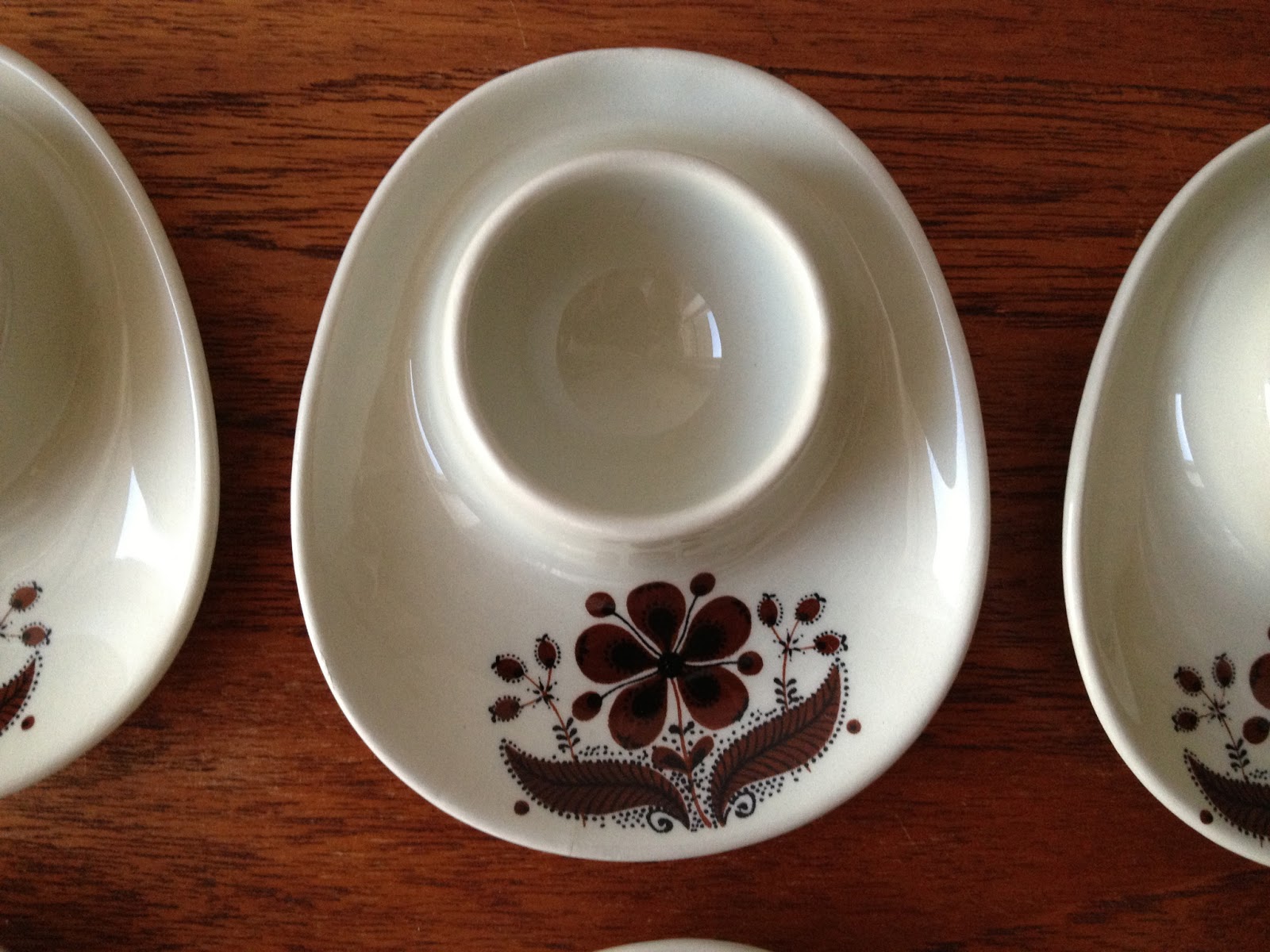
Now some more on the egg cup matter. I´m constantly on the search for Figgjo egg cups, and was happy to find six. The pattern is Hedda (1977-80) by Rolf Frøyland who, alongside Turi Gramstad Oliver, was a local designer with a lot of great patterns on his conscience. It´s a pattern I haven´t really collected before and can´t really remember from way back when, but the brown pattern goes very well with all my other brown stuff and the Egersund Korulen set that I often use for breakfast, a real yellow and brown 70s combo. I also have two egg cups in Tor Viking that you can see in this post. That´s a pattern I do remember and cherish, we had it when I was growing up.
The design, however, is by Ragnar Grimsrud from the 60s and is pure genius. You can put your egg shells or your salt, butter or little pieces of anchovies in the little bowl. Due to their shape they also stack really well. These egg cups are quite hard to find, so if you come by one, grab it and run. I try to collect some light blue ones for my mum, she only has a few of her old ones left, so I´m hoping to find her some more.



Another handled dish! This time a danish studio piece by KK Denmark. I found a small dish with that same stamp earlier, shown in this post, the pattern is almost identical. I still haven´t been able to find out who the maker is. Anyone?

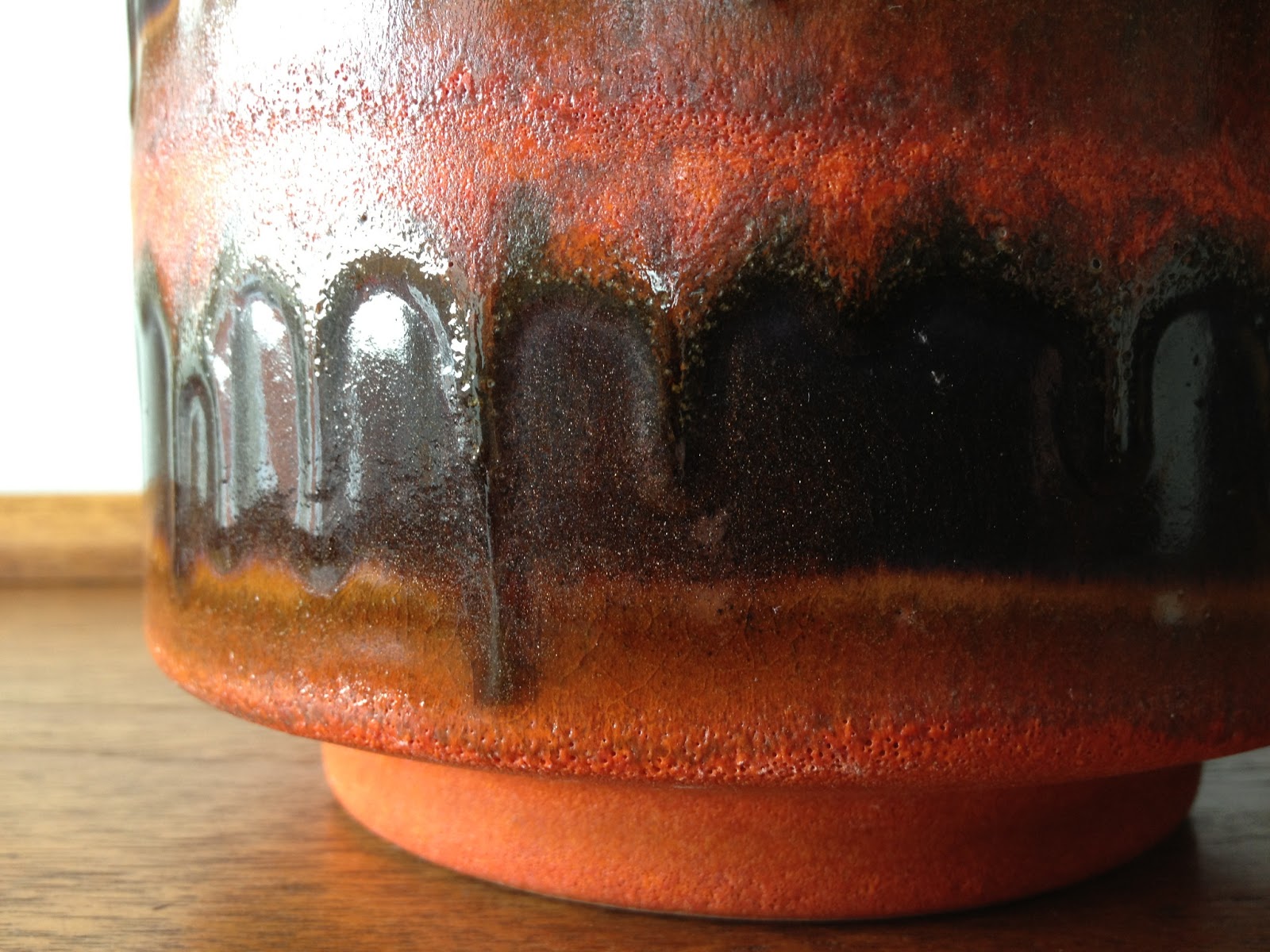
This vase to the right is another mystery piece, though I´m quite sure it´s norwegian. I love the combination of the rough surface and the refined glazed top. The red ladybug wall plaque is made in the 60s by Pottemaker Simonsen, a local Sandnes pottery maker who are still making the traditional brown household pottery that I mentioned in the beginning of this post, and have been doing so for several generations. They have this wonderful workshop and shop in the center of the town. I visited on a rainy day (yes, it often rains there...) when the streets were very quiet, and was asked if I wanted a tour of his workshop. Would I ever?!? It was so great to see everything, the tools, the different stages of the drying prosess etc. I commented on the ladybug hanging on a wall in the workshop, and the pottery maker said it was mine if I wanted it!!! They make the jars with the white lines, my old ones are plain brown. The bowls, however, I´ve only seen with the lines around the edge.


I`ve left my beloved coast now and started working again. I desperately
want to go back, I´ll have to try to squeeze in a weekend there soon, I
miss it like crazy.
PS. I´ve linked in with Max over at Blackbird has spoken. Pop over and have a look at her lovely blog!
PS. I´ve linked in with Max over at Blackbird has spoken. Pop over and have a look at her lovely blog!