Showing posts with label 60s. Show all posts

Tuesday, July 23, 2013

Thrifting heaven

My home town proved to be thrifting heaven. The concentration of pieces by Figgjo and Stavangerflint is higher here, after all, this is where it all was made, and the Egersund factory was just an hours drive further south. I guess the selection of domestic pottery in the stores wasn 't quite as large and international as now. There is also the fact that a lot of people bought their sets directly from the factories, both for the discounted prices and out of loyalty to those local companies. The generation that bought Figgjo and Stavangerflint for their homes during their 60s and 70s heydays were of course our mums and dads. Many of them are now are now in the process of selling their houses and downsizing both their homes and number of dinner- and coffee-sets, so consequently these are now up for grabs. I'm so glad mine still live in my childhood home, it's a typical late 60s/early 70s one story house, so no steep stairs:-)

I thrifted with my mum, who's closets and drawers are even fuller than mine:-) I wish I had her around for every thrift round, we had such a nice mother and daughter time! She thinks her house is full enough, though, so she doesn't search for anything particular. Only egg cups. I'll get to that.

When I'm over, I'm mainly looking for local stuff, Figgjo and Stavangerflint goes without saying, but Graveren pieces and older Sandnes pottery are also a thrill to find. I found this traditional storage jar and baking bowl, both made at Sandnes potteries. They're common household pieces from pre- plastic times, and all our grandmothers had them. They were probably the last generation to use them in the traditional sense. My dad told me he remembers his mother also used her bowl to mince fish for fish cakes. They were made both by Graveren, Gann and Eie, a former Egersund pottery. I usually put a plant in mine. They can rarely be found flawless, but I guess the small beauty marks are part of the charm, years and years of use by hardworking women with their bread doughs makes them very precious. The jars are glazed inside and out, the bowls only inside. You can see another post about the traditional Sandnes pottery here.


Graverens Teglverk was founded in 1852, the production of colored ceramics started in 1926. Until them, Graveren had only produced brown traditional pottery that had been produced in large amounts ever since the 17th century, due to the high quality and good supply of clay in the area. The Sandnes potteries also produced roof tiles, that were even in some cases used on walls due to the lack of timber. Graveren was for a long time the largest pottery in Sandnes and was known to hire great artists.

Graverens Teglverk merged with Ganns Potteri in 1976 and became Gann Graveren. The ceramic production was closed down in 1982, and today, even the roof tile production is history.

Many artists were connected to Graverens Teglverk. Ragnar Grimsrud (who also worked for Figgjo and is considered one of our most talented pottery makers of the 1900s) is perhaps the most renowned, and became head designer (artistic leader) in 1928. His wife, Elsa Grimsrud, was the company's first decorator (illustrator? Neither sounds right...) His work was among the most appreciated during his time in the company, and after Graveren's participation on the paris fair of 1925, one of his pieces were added to the collection at the ceramics museum in Sevres. William Knutzon took over in 1946 and was there until 1949.

I don't know who made this large plate by Graveren, but I fell in love instantly. The art deco inspired pattern makes me guess it's from the 20s or early 30s. If anyone has some information about this or similar pieces, please give me a holler, as I'm dying to know more about it! I think the colors are wonderful and the pattern reminds me a little bit about some Egersund pieces I've seen at the fayence museum.


Speaking of Egersund, I was lucky enough to find a Korulen breakfast/ lunch set for eight a while ago, as well as various serving dishes. They are rare finds in thrift stores. In Stavanger I found six more plates in that same pattern and a yellow milk jug. The design is called Unique (Kaare Blokk Johansen) and came in, as far as I've been able to find out, the Korulen pattern (Unni Margrethe Johnsen, in production from 71-76) and two color combinations, brown with orange accents and this orangey, sunny yellow with the brownish green. For the color of the milk jug I've only seen the name Unique, the decor/ color combo might have another name. I love the sunny milk jug combined with the Korulen pattern, even more that if it had the same pattern. It sure is a sunny way to start the day:-)


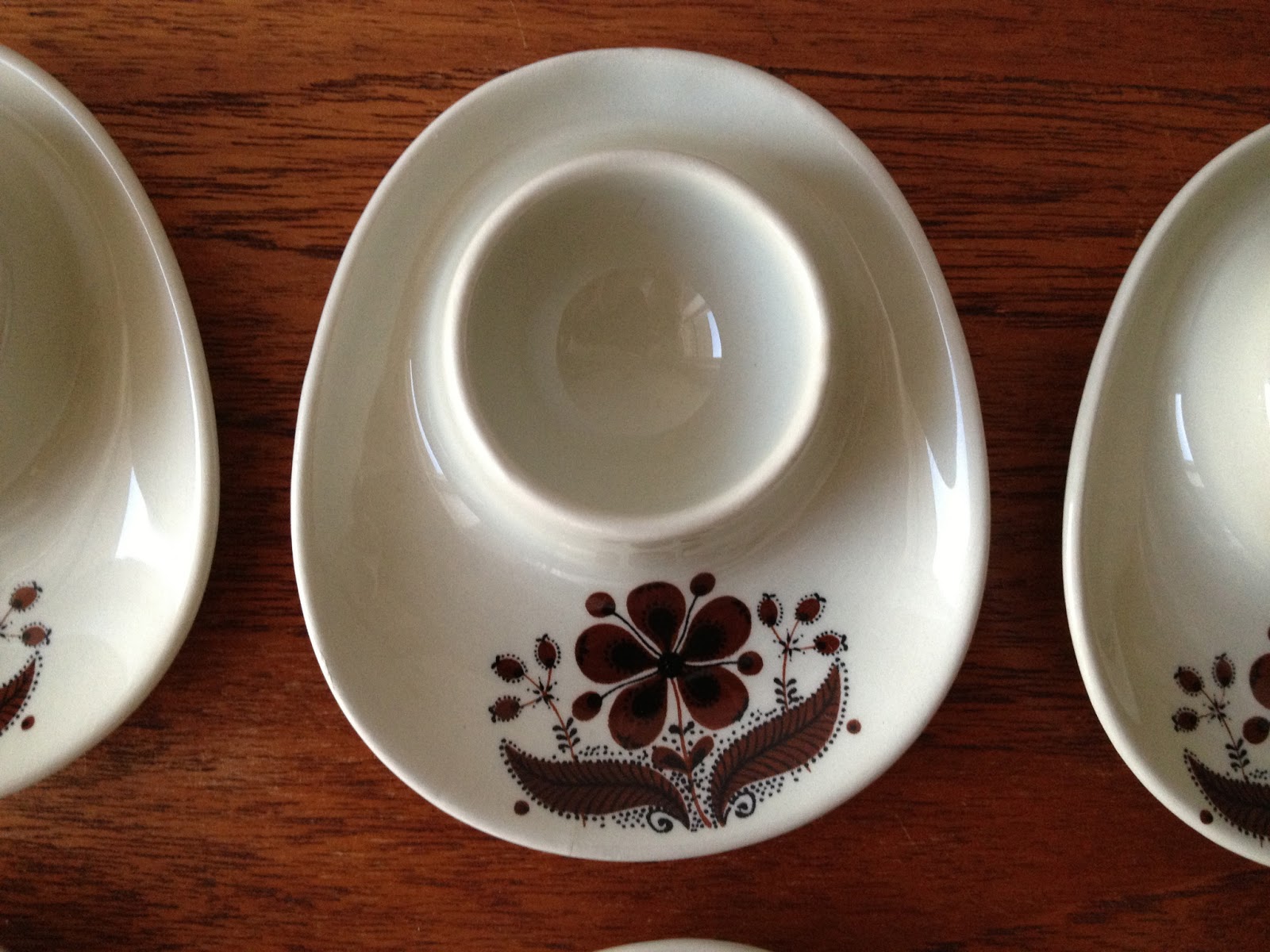
Now some more on the egg cup matter. I´m constantly on the search for Figgjo egg cups, and was happy to find six. The pattern is Hedda (1977-80) by Rolf Frøyland who, alongside Turi Gramstad Oliver, was a local designer with a lot of great patterns on his conscience. It´s a pattern I haven´t really collected before and can´t really remember from way back when, but the brown pattern goes very well with all my other brown stuff and the Egersund Korulen set that I often use for breakfast, a real yellow and brown 70s combo. I also have two egg cups in Tor Viking that you can see in this post. That´s a pattern I do remember and cherish, we had it when I was growing up. 

The design, however, is by Ragnar Grimsrud from the 60s and is pure genius. You can put your egg shells or your salt, butter or little pieces of anchovies in the little bowl. Due to their shape they also stack really well. These egg cups are quite hard to find, so if you come by one, grab it and run. I try to collect some light blue ones for my mum, she only has a few of her old ones left, so I´m hoping to find her some more.


Another serving piece, this dish is Stavangerflint Sera, designed by Inger Waage and in production from 1970 to 79. I love the shape with the handle. It looks like it originally had a lid, and I can imagine how the lid looked like. It´s in the smaller end of medium sized an will be great for vegetables. I even use dishes like these for fruit or popcorn. It´s from their oven proof line so it can also be used for an oven dish. I´m always terrified of putting these treasures in the oven, though....


Another handled dish! This time a danish studio piece by KK Denmark. I found a small dish with that same stamp earlier, shown in this post, the pattern is almost identical. I still haven´t been able to find out who the maker is. Anyone?


This vase to the right is another mystery piece, though I´m quite sure it´s norwegian. I love the combination of the rough surface and the refined glazed top. The red ladybug wall plaque is made in the 60s by Pottemaker Simonsen, a local Sandnes pottery maker who are still making the traditional brown household pottery that I mentioned in the beginning of this post, and have been doing so for several generations. They have this wonderful workshop and shop in the center of the town. I visited on a rainy day (yes, it often rains there...) when the streets were very quiet, and was asked if I wanted a tour of his workshop. Would I ever?!? It was so great to see everything, the tools, the different stages of the drying prosess etc. I commented on the ladybug hanging on a wall in the workshop, and the pottery maker said it was mine if I wanted it!!! They make the jars with the white lines, my old ones are plain brown. The bowls, however, I´ve only seen with the lines around the edge.


More planters.... These are unmarked, but must be german. I have some other german ones that have that same lava glaze. I also found this Haldensleben vase (below) in the very same pattern that I have on two other pieces. They´ll make a nice trio.


Muy mum found this Marbell stone art piece for me, of this peaceful- looking little boy, isn´t it adorable? I´m usually not much for adorable, but this one is irresistable. I have another one of these belgian stone pieces that I got earlier, it´s far more abstract. There´s very little to be found on the web about Marbell stone art, so I don´t know a great deal about them, other than remembering them from the time I lived in Belgium.


The last piece this time is my very first Midwinter Stonehenge piece. the pattern is Greenleaves, which both mum and I fell for instantly. It´s just a single dinner plate, but I guess I can serve something from it, cookies maybe? I didn´t know before looking at it now that Midwinter is part of the Wedgewood group.


That was it, really, except for one lovely print by a local Jæren artist, which I left behind with my parents. They will visit this fall and bring it along. I´ll be sure to show you:-) I found so much on our first round that I had to stop, concidering we we' re travelling by plane... A few days later, I popped into a store that was so full of Figgjo that I had to rub my eyes. And at such good prices. The store owner assured me that she always had this much, so not to worry, I would find just as much on my next trip home. Look at it!!! I already knew my luggage had reached it´s maximum weight for the plain ride... I´ll definitely go back, but what to choose when faced with all that gorgeousness?? It´s gonna be hard...


I`ve left my beloved coast now and started working again. I desperately want to go back, I´ll have to try to squeeze in a weekend there soon, I miss it like crazy. 

PS. I´ve linked in with Max over at Blackbird has spoken. Pop over and have a look at her lovely blog!

Wednesday, July 17, 2013

Great stuff at mum and dad's

I'm blogging from my mum and dad's in Stavanger where I'm spending the last week of my vacation. I'm using the Blogger app for the first time, and have finally found a way to change the font, it startes out looking very strange. I just thought I'd show you a couple of things from my childhood home that I really love and at the same time try it out:-)

Every time I'm visiting, I'm drooling over this rye (the Norwegian term for rya) that they made in the 60s. I hope some day it might find it's way to my home... You could buy sets with the pattern and the materials you needed. Sellgren is one of the well known brands that made these, but also Husfliden had some great ones, that's where this comes from. I absolutely love the modernist abstract tree pattern and the colors, cream, different shades of grey, black and teal. Mum told me yesterday that the background was supposed to have more pattern, but I love how it turned out.


My parents were married and set ut home in the late 60s and consequently have a lot of scandinavian 60s stuff. They have this great pendant, a brass “Nova,” designed by Jo Hammerborg for Fog & Mørup in 1963. It has some dark spots, and they have been looking for a replacement several times, but can't find a lamp that matches the colors and style of their living room and that gives the same beautiful light as this one. I think they're convinced there's no other lamp quite like it:-)


Among all the Figgjo and Stavangerflint they have (after all, this area is the home of those goodies), there are also some great pieces of studio pottery. I've always liked this Danish vase they got as a wedding gift in 1966. I don't know who the maker is, maybe some of you might know?


I've been thrifting too.... I found a box full of goodies yesterday on an op shop round with my mum and the guys. I also got some great planters that belonged to my grandmother. I'll show you when I get home and get them cleaned and photographed:-)

Monday, April 01, 2013

How wrong could I be? Or Manrique, part one!

I hope you all had a great Easter! I've been away for a week and have fallen in love in the most unexpected place, not with a man (I already have one:-), but with an island and a local artist/ architect.
If you're european, you probably know the Canary islands. For those of you guys overseas who might not know them, these islands are spanish, but are located further south in the Atlantic ocean, off the Maroccan coast.They're known for their great climate year around, and are popular winter destinations when the Mediterranean is too cold.
My mom and dad invited my family and my sister's to come celebrate my mom's 70th birthday in a house they rented in Lanzarote. I must admit my first thought was 'oh no, not the Canary islands...'

I'm kind of allergic to mass tourism, and to me these islands are quite stigmatised in that respect. But boy, did I have to eat my words, or thoughts, rather! I've been to a couple of the other Canary islands in my 20s, and remember them as something I would not be drawn to today, but Lanzarote was quite different! We stayed in a house in a small village and avoided mass tourism all together. I was quite impressed with the restricted policy towards tourism, and how they'd managed to preserve the landscape and local building traditions. The latter, we were told, was much due to local artist/ architect Caesar Manrique, who spent years abroad, but returned to his native Lanzarote and did a great job in using his connections in high places to persuade the authorities into preserving the island's unique qualities and resisting the pressure from the charter companies.

The Canary islands are all volcanic, but in Lanzarote, the numerous volcanoes had massive eruptions as late as the 17- and 1800s, which has given the island the most peculiar landscape. It's so dramatic, with great encounters between the ocean and the extremely rugged coast.


I want to show you some of Manrique's great art as well as the three buildings I found most interesting.They're all pretty amazing. The artworks he's most known for are his large- scale sculptures, that are scattered across the island. Many of them are kinetic, moved by the wind. The lava landscape combined with sculptures that really capture the elements and a great period, really got to me. I see a lot of both Picasso and Miro in his work. Although not a trained architect (he had an art education), Manrique had strong ideas about architecture, that he realised in collaboration with trained architects. His buildings are very sculptural and organic.


The following images are from his home and studio, containing amazing living spaces actually inside the lava. By looking at the lava landscape that surrounded him, it's not so hard to understand his obsession to live in it? The house was built in 1968 on top of a volcanic trail from an eruption in 1730-36. It uses, in the lower level, the natural formation of five volcanic "bubbles" to make an unusual living space within a natural space. It's unbelievably cool. That great 60s vibe, the artworks, the lava, what's not to like? The outside of the house and upper level is inspired by the traditional local architecture, and contains exibition spaces with great works of art, both by Manrique and others. The courtyard has an enormous Manrique mural, as well as several great sculptures. I'll be showing you two other amazing manrique buildings later- to be continued!


Related Posts Plugin for WordPress, Blogger...