Showing posts with label Kaare Block Johansen. Show all posts

Tuesday, March 25, 2014

Eight Norwegians and a Finn

There hasn't been much time for thrifting lately, and I haven't been very active on the blogging front. I hope some of you are still around... The process of taking over the company I work for has drained me, we also have an huge amount of projects, big and small. Which is good. I guess.....Still, being creative and innovative when there's so much on your plate is not always easy.

I finally managed to pop by a couple of thrift stores this Saturday and found some nice pieces. Apart from Figgjo and Stavangerflint, both brands from my home town, I love Egersund fajance, as I'm sure you've noticed:-) What I find particularly interesting is that the factory produced for such a long time and covered a broad spectre of periods. The pieces I found on saturday represent two of them, the 70s and the 30s.

I'm falling deeper and deeper in love with Unique, their eggyolk colored design from the early seventies. I adore the cheerful, shiny 70s vibe and the handpainted touches. I find both the colors and shapes to be so very typical for that decade of bright colors and great graphics. Unique was designed by Kaare Block Johansen in 1971 and was in production until 1976, just a few years before Egersund Fajance closed down in 1979.  I've found quite a lot of these by now, and use them daily, mixed with Korulen. You can see the amazing teapot and cups in my previous post and find more information about both Unique and it's "sibling" Korulen here and here. This time I found two large serving dishes and a lidded sugar bowl, all in mint condition.


The factory made some rather lovely art deco pieces, this latest one I've found has a pattern which is very typical for that era. I have a few more art deco pieces by Egersund fajance, but sadly have not been able to find out anything about the artists behind them. 


I found this large and lovely Cathrineholm casserole in a design which is not so common. It may be inspired by the Finel mushrooms, or the other way around, I don't know which came first. The pattern is in a deep, muted green and the greyish white background has a hint of green. It's in great shape and the best part-  I got it for next to nothing, 75 kroner (equivalent to 12 USD or 9 euros)!!


A while ago, I found some Stavangerflint "Mesterkokken" ("Chef") dishes in reddish brown, yellow and teal, designed, silkscreened and handcolored by Inger Waage. This Saturday, I found three plates in the blue version of the design. I don't have much blue in my home, but I couldn't resist these. The pattern and color of these blue ones makes me think of Delft, I wonder if she was inspired by their lovely designs? "Mesterkokken" was introduced around 1960, I haven't been able to pinpoint the exact year. One of the dishes I found the last time originally had a lid, but as is often the case with vintage lids, they've gone missing years ago. I've seen in old ads, though, that both color combos had brown lids. See my previous post on this design here.


I'll leave you with my most cheerful find this time, this gorgeous Arabia Finel enamel pot, designed by Kaj Franck. The pattern is by Esteri Tomula, a great graphic designer from Finland who is the woman behind numerous  amazing Arabia designs.


Sunday, February 16, 2014

Sunshine on a grey day

It was such a treat to find this sunny teaset in these grey, wet and foggy times. Egersund Unique is handpainted and the pieces therefore have an individual look. On the olivegreenish/ brown edges you can clearly see the brushstrokes. Unique was designed by Kaare Block Johansen in 1971 and was in production until 1976, just a few years before Egersund Fajanse closed down in 1979.

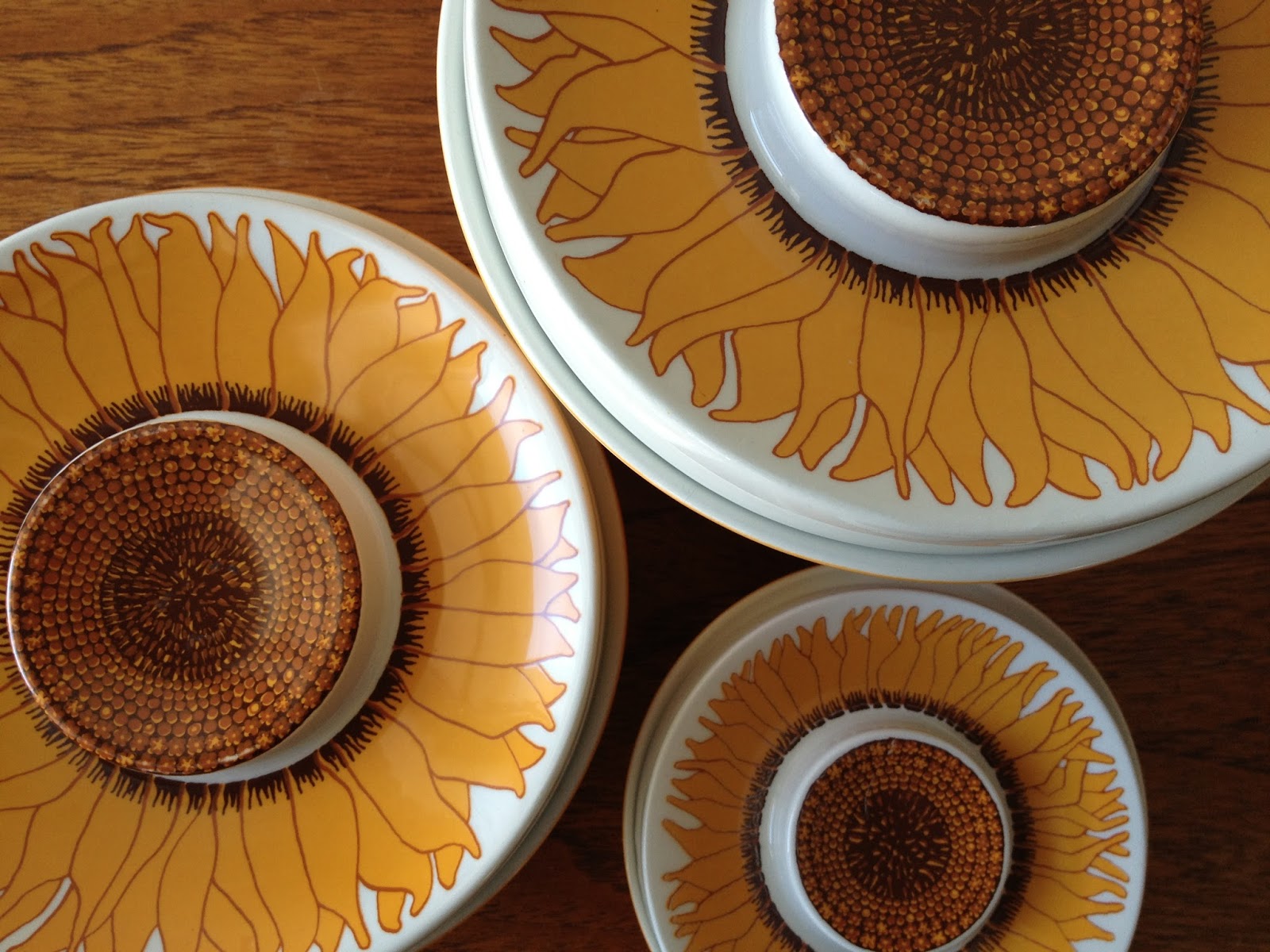
Unique has the exact same design as Korulen, also by Kaare Block Johansen, but which has a lovely sunflower pattern by Unni Margrethe Johnsen. I have found quite a bit of both of these sunny designs. I so love the colors and those amazing early 70s lines. The teapot is simply amazing!

I've written quite a bit about these before, so I won't bore you by repeating myself. If you're interested, you can find quite a bit of information here and here. Wish you all a great week!


Monday, August 19, 2013

Egersund Unique

They are, arent't they? Simple, yet unique? This post is gonna be a sunny one, color and pattern- wise:-) I got these last weekend too, together with the pieces in my last post, but decided they deserve a post of they're own. 

Egersund Unique is handpainted and the pieces therefore have an individual look and on the olivegreenish brown edges you can clearly see the brushstrokes. Unique was designed by Kaare Block Johansen in 1971 and was in production until 1976, just a few years before Egersund Fajanse closed down in 1979.

There's very little information to be found about Kaare Block Johansen, which is strange and sad, as he made these wonderful and iconic designs. I've found however, that he was at the factory from the 50s and that he was their last remaining designer before they closed down. 


Unique was very popular and has become an icon of norwegian early 70s design, I guess it captured the sunny happy vibe of that decade really well. I found the milk jug in Stavanger this summer. With this color, they're easy to spot:-)


I have a Korulen set from an earlier catch, with two large serving plates and three lidded bowls. I know I've shown you before, but these two need to be seen in relation. The lids are especially gorgeous. Korulen is exactly the same design by kaare Block Johansen, but the sunflower pattern is designed by Unni Margrethe Johnsen. Johnsen finished her education at Statens håndverks- og kunstindustriskole in 1966 at the age of 24 and were immediately employed by Porsgrund Porselænsfabrik.

She was characterized as a breath of fresh air. Not surprising, seeing her wonderful design. For the next nine years, she designed both for PP and Egersund Fayanse. From the mid 70s she set up her own studio, where she consentrated on working with clay. Her work from the mid 80s and early 90s are concidered her most artistically significant. I wish I could find some examples. Sadly she passed away in an accident in 2001, only 59 years old. 


The great thing with these two designs is that they mix really well. Just look at those sunny concoctions below!


When I tell you the design is from 71, it's no typo. I haven't been able to find out what the number 73 stands for, it might be the actual production year. Notice how the handpainted Unique is marked differently.

Wanna know some more about Egersund Fayanse? It was founded in 1847 under the name Egersunds Potteri by Johan Feyer who himself was a pottery maker, trained in Newcastle upon Tyne. Feyer brought english pottery makers to Egersund to teach the craft to local workers. For the first 20 years, the factory produced the brown pottery that this region is known for (see examples here) made from local clay. In 1851 the factory had 26 employees.

In 1863 Feyer started the transformation prosess to start producing white pottery, the so- called fajanse, and the factory was renamed Egersunds Fayancefabrik. They hired swedish pottery makers from Rørstrand and english labourers. The fayence was produced out of a mixture of clay, kaolin, danish flint and norwegian quartz. The first years, pottery with a simle decor were made, often transfer prints, inspired by other makers, magazines and so on. Eventually, the company developed a strong artistic profile, and were associated with artists like Kitty Kielland, Jacob Sømme (who designed one of their most iconic products, the Puffin jug), Oluf Wold-Torne, Andreas Schneider, Andreas Ollestad, Jacob Bjorheim and Theodor Friestad. Alongside everyday household products, they also made more prestigious pieces, like enormous vases for exhibitions (you can see an example in this post, a large art nouveau piece from 1910 by Andreas Ollestad). 

The factory burned down in 1905, but was rebuilt in 1907 with bigger capacity and electrical power. It expanded profoundly in 1950 to meet the demands of the post- war years, and the work force were close to 500. The harsh demands of mass production eventually forced them to join forces with other companies. In 1967, the factory merged with Porsgrunds Porselænsfabrik, from 1975- 77 they were owned by Arabia and from 1978 by Upsala- Ekeby, until they were closed down in 1979. To my understanding, they produced locally under their own brand until the end.

For more than 132 years, the factory produced a wide variety of designs, that shows the various trends within the art- and design world during that period, from the brown household pottery, to elaborate art nouveau pieces, cutting edge art deco and early modernist designs and the "golden age" of scandinavian pottery, the nation- building post- war years. Many examples are shown in the wonderful Egersund pottery museum, have a look over here.

I keep thinking what other great designs they could have made if they weren't closed down. But I guess, as we can see with Figgjo, which is still up and running, the market changed, the import increased and they have generally been faced with more competition and new demands. What was produced at Figgjo after the 70s and early 80s has not by far reached the same iconic status as their earlier designs, and they have concentrated on the professional market, restaurants, hotels and cruise ships.  Luckily, there's still quite a bit of their designs from those golden years out there for us to enjoy!

PS. I've linked up with Max over at Blackbird has spoken for her Op shop Show- off! Head on over to behold some lovely thrifted stuff!
Related Posts Plugin for WordPress, Blogger...