Showing posts with label Tapio Wirkkala. Show all posts

Saturday, December 21, 2013

Merry Christmas!


Work and life has been crazy busy this fall. I've completely lost my thrifting and blogging mojo, but hopefully it will return! I have been reading all your lovely blogs, but I haven't been able to comment as much as I would have liked. 

So what's been going on? In short, the founder of the office I work for, a true modernist and a great architect, has turned seventy and has asked me and a few of my colleagues if we want to take over the practice. He started it 40 years ago and we have a solid position in the city we're based. We are 8 architects, small enough to enjoy the benefits of short decision lines but big enough to take on large projects. So this fall and winter, there's been a lot of time spent on negotiating all the details about the take over. It feels a bit overwhelming right now, but it's gonna be exciting!

Yesterday was my last day at work before Christmas. We always dress up a little, have a delicious meal together and give eachother gifts before we part for the holidays. In the evening we had my parents and my sister's family over for a get together over my dad's wonderful bacalao, celebrating Christmas a little in advance, because we won't be home. My husband, who is a pilot, has a flight to New York with a four day layover, and instead of spending the holidays apart, the boys and I are tagging along. So the holidays will be a little different this year. But Christmas is where the family is, right? The boys are thrilled, and that's the most important thing.

I want to wish every one of you lovely friends out there a wonderful Christmas and all kinds of happiness in the coming year!

All the best, Tove

Saturday, October 12, 2013

From Finland with love


I adore finnish design. Yesterday, my dream find arrived!! I've found what's been on the very top of my wishlist for a very long time on Finn (Norway's Craigslist)- the Ultima Thule caraffe. It's so incredibly gorgeous, I absolutely adore this series by the amazing Tapio Wirkkala, designed in 1968. It's so breathtakingly beautiful, looking like eternally melting ice. The design is both beautiful AND intriguing, I keep noticing more great details all the time. The work of that bearded, pipe- smoking, natureloving guy is unlike anything else. As mentioned in a recent post, collecting the tumblers takes a lot of patience, the few that find their way to a store over here, is snatched away before they even hit the shelves. But my goodness, finding them is so rewarding, they are simply the most gorgeous glasses on this planet.


My heart always beats a little bit faster whenever I find new pieces of Arabia Ruska. I adore finnish design, and to me, Ruska is Finland, the roughness, the dark woody brown, the simple shapes, I love it. Just like Ultima Thule, it has a very Nordic feel to it. This masterpiece by Ulla Procope was introduced in 1961-62, and was in production for more than three decades, I'm guessing much due to it's modern and rustic appeal. Lucky for us, this makes it fairly easy to collect, as I know many of you do. It never seizes to amaze me that it was designed as early as it was. If I didn't know, I would easily have guessed the 70s. Earlier I've found the lovely teapot, dinner plates for twelve, several serving dishes and a teaset. Below is what I found yesterday in the Salvation army store. At ridiculously low prices, I might add.


I love the shape of the creamer, simple, low and wide.


Six coffee cups. I have eight teacups already, and often prefer the shape of teacups. But these coffee cups are even more gorgeous, so straight and tall. The only problem with Ruska is that the cups don't stack well... I do forgive them, though, since they're so gorgeous.


I haven't seen this dish before. It's an oven dish, but I can find so many other uses for it too, I adore the shape. It has the first stamp I've seen with the name Ruska on it.


I have this large round serving plate already, and have always wanted one more. I use it for everything, cake, salad, pizza and traditional dishes like a roast. 


Autumn has been at it's very best here today. Gorgeous weather and breathtaking colors. I went for a walk and I'm leaving you with a couple of snaps of a house here in my neighbourhood that I'm really curious about. With it's dark brown facades surrounded by Nordic foilage it seemed so fitting to throw it in after the Ruska. Although it's close to the road, it's hard to photograph. Despite it's very geometric appearance, it blends in with the foilage. Much due to the coloring, of course. It's designed around the end of the 60s. it has a square plan and an atrium covered by the glass pyramide you can see on the roof.  I'm hoping one day I'll get the chance to see it inside. I'll be sure to share it with you if it ever happens! Enjoy the rest of your weekend!


Ps. I just linked up with Max over at Blackbird has spoken, do pay her lovely blog a visit, I highly recommend it!

Sunday, June 09, 2013

Pieces of teak, glass and pottery


This weekend has been one of the really great ones. The weather has been sunny and warm, allowing us to have all meals out on the terrace. I love that. I didn't think I'd be doing much thrifting, but I squeezed in a small stop on my way home from work on friday, and a small trip late this afternoon. I found some stuff that I don't usually find, which was very exciting. At the local salvation Army store on friday, I found another Ultima Thule tumbler (for information, look here). I collect them, and really hope they keep turning up.

.
There was also another Kosta Boda snowball votive holder, designed by Ann Wärff in 1973. I found two last week, so there's now a trio.


More glass, I found three small smoky grey Hadeland Fersken (peach) dishes, an award winning design by Willy Johansson in 1956. I guess they were originally designed as individual butter dishes, but I can also imagine they'll be great for soy or ponzu sauce for sushi.


I found this Figgjo Market piece designed by Turi Gramstad Oliver. Market is a rare find over here. A quick search on the web reveals where they all are... (rather large continent to the west:-) I have this one and a lidded serving dish. Unfortuneately, the lid was repaired with glue after having been broken, as is often the case with these. The lids are heavy and fall off very easily. I guess it will get a new life as a small planter in my kitchen in the company of two siblings, Folklore and August. You gotta love those quirky market scenes with all the glorious detail! The butter boxes were designed for what used to be the exact shape of a package of 500 grams of margarine here in Norway. That was later changed into a more rectangular shape, and consequently, Figgjo started making the lower rectangular butter boxes, like my Folklore one below (More Folklore here and here). 


Also, waiting for me when I came home on friday, was a package containing a four ring Festivo for my new collection, a bargain on Etsy. I now have three!!


Saturday was spent in the garden, doing a little bit of grooming. Today, my husband left early for New York, the kids were off with friends and I felt like a bit of thrifting:-) For a long time I've been curious about a lady who regularly has ads on Finn (the norwegian equivalent to Craigslist). She lives a 40 minute drive away from me, and I decided it was time to pay her a visit. She sells all kinds of retro pieces, and has an impressive glass collection. She has a room she calls the "retro room", which is covered in teak shelving full of treasures. She uses what she earns from her sales to restore her beautiful art nouveau house from 1906, and who wouldn't want to sponsor such a noble deed? I hope she doesn't mind me publishing a photo. Her current project is to restore the windows. I have to admit, the house itself was half the purpose of my trip. I love art nouveau, both my own home town and my mother's (Ålesund) has a lot of it, and I think I really fell in love when I lived in Brussels at the age of 15- 16 and visited Victor Horta's house. For you foreign guys, this is what our wooden art nouveau houses looks like. Isn't it beautiful?


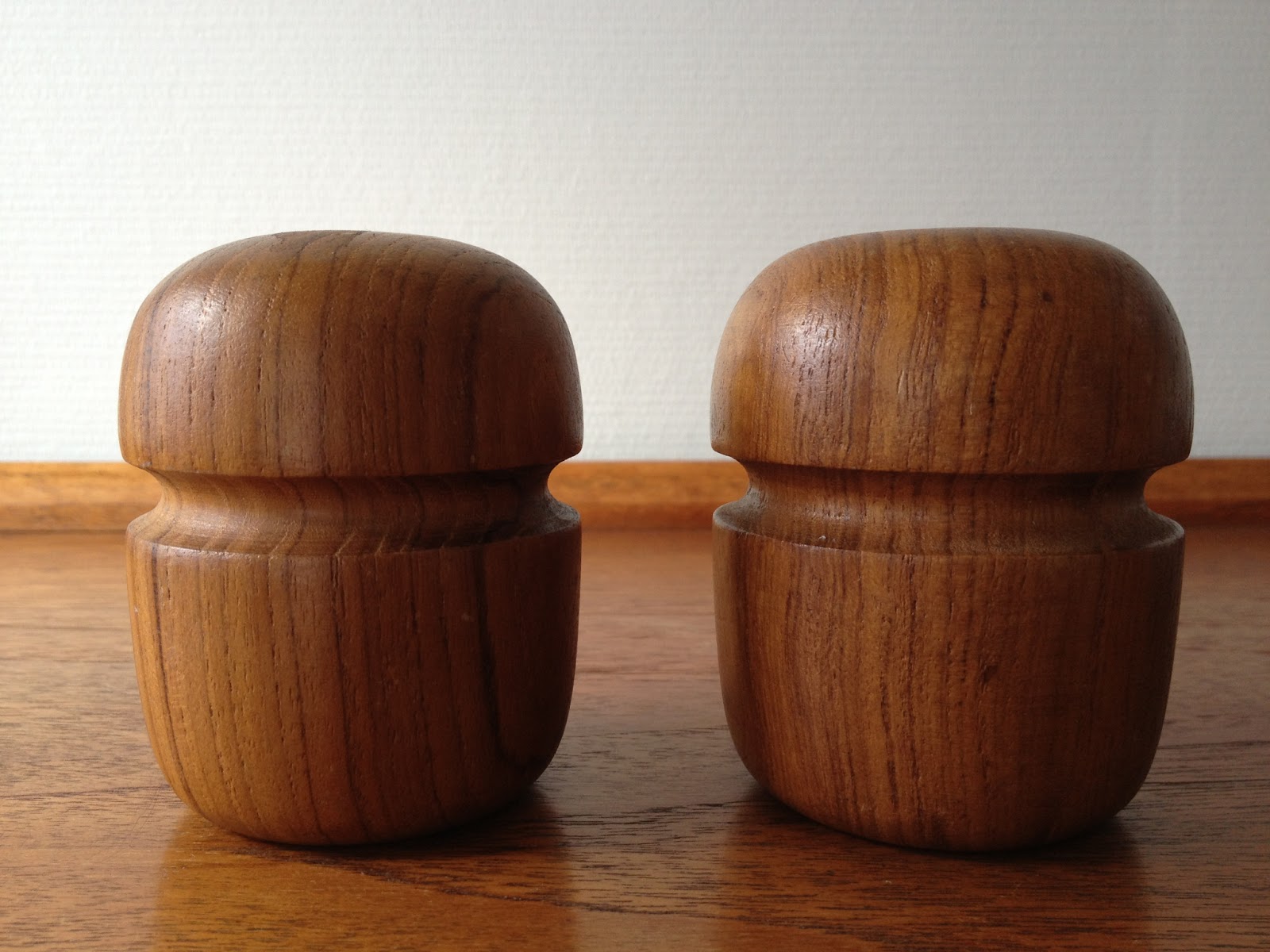
I could have bought pretty much everything she had on display, but I really needed to restrain myself. A few goodies came along, though, and I will definitely be going back! The first things I fell for are these wonderful salt and pepper shakers and the salad servers and spoon in steel and teak. I'm not sure who designed the salt and pepper set, but they're most probably danish. They're large and heavy, and I will give them a light sanding and coat of oil to bring out that beautiful lustre. The salad servers and spoon are so incredibly elegant. I've seen them before on the web and have been hoping to find them one day. I know for sure they're norwegian, and I think they're designed by Thor Bjørklund who invented and patented the typical norwegian cheese slicer in 1925. I'll have to see if I can find out some more.


Next pieces I found are two Hadeland Multe bowls, also in one of my favorite glass colors, smoky grey. The Multe (cloudberry) series was designed by Willy Johansson in 1966, and was awarded "Merket for god design". I'm not sure how to translate that, but it's an award where both form and functionality is taken into consideration, given by the norwegian design counsil. They're so beautiful and simple, and I've been looking for one of these to fit the "upper deck" of my Digsmed lazy susan. It has small bowls in the same color and room for a bigger bowl on the upper level. I don't think there was one originally. 


The sweet lady had an impressive glass collection. It was hard to decide what to pick out, but what I couldn't leave behind were these modernist owls by norwegian artist Benny Motzfeldt (1909- 95). She was an amazing glass artist with a large and varied production. Aren't they gorgeous? They're not large, but very heavy, and will work as paper weights or just great sculptures.


The next piece I got was such a thrill to find. I've never seen Kronjyden Relief in thrift stores over here, so this is my first piece, a candle holder, hopefully there will be another one to join it. I love the color and the pattern, and totally agree with Birgitte, over at The Little Black House, that it resembles a danish (or norwegian for that sake) cornfield rather than something assosialted with leaves. "Relief" was designed by Jens H. Quistgaard in 1959-60.


After leaving the beautiful art nouveau home of the sweet icelandic lady, I made a quick stop at an antiques barn. They mainly have older pieces, but look what I found! A Figgjo Tor Viking lidded serving dish! It reminds me so much of growing up, we used to have this at home.Apart from this piece, I now have four small plates, two egg cups and a creamer and sugar bowl that was my mom and dad's.


Sunday, May 26, 2013

Tribute to Tapio


Isn't this picture of Tapio Wirkkala amazing? (Image courtesy of Rut Bryk Foundation) He was such an incredibly talented designer/ artist who didn't really want to draw a line between the two diciplines. I find that very evident in his work. I've always loved  his Ultima Thule series, designed in 1968. It's so breathtakingly beautiful, looking like eternally melting ice. The design is both beautiful AND intriguing, I keep noticing more great details all the time. The only downside is that they don't stack, but I totally forgive them, and could easily clear out all my other glasses to make room for them.

Imagine my joy this morning when I found an ad for 7 of these beauties! Turned out the seller was fairly local too, and I was able to pick them up just an hour later! Until now, I've only found four dessert bowls. Ultima Thule is still being sold in shops over here, but buying them new in a shop somehow feels like cheating. Besides, I love the idea of great design being passed on rather than gathering dust in a cabinet somewhere.

My lucky find today consists of one large beer/ longdrinks glass, three large tumblers and three small ones. When I came home and unwrapped them, I noticed that the seller had thrown in a beautiful small creamer too. The weather is so amazing here today, we've had clear blue skies and temperatures in the mid 20s. With the sun bathing my living room in it's rays, I couldn't stop photographing these beautiful icicles.


Did you know they were originally designed for Finnair? They were comissioned for their new route between Helsinki and New York in 1969. Wirkkala also designed plastic tableware and cutlery for the same route. The plastic products were produced by Fiskars, the Iittala Group's parent company today. Ultima Thule has become one of Iittala's most popular glassware ranges ever.

When holding an Ultima Thule piece in your hands, the image most likely to come to mind is of a block of ice that has melted, as if by nature, into a glass. In reality, the rough exterior characteristic of these glasses was the result of years of development work: "For years now, I have been pursing the ideas expressed in these glasses. Earlier, I tried breaking up the surface by cutting, but only now do I think I'm on the right track when I get the desired result in the glass-blowing stage."

The birth of the Ultima Thule range of glassware in 1968 tells us a lot about Wirkkala's approach to design. Inspired by the melting ice in Lapland, the form he created for Ultima Thule is based on what is known as the ice glass technique, which Wirkkala was involved with in developing at the Iittala Glassworks. Always the innovator and always keen to roll his sleeves up, Wirkkala did this part of the job himself at first. The original molds for the collection were hand carved by Tapio in wood, so that the first pouring of hot dripping glass altered the mold as it ran down the sides, making the distinctive dripping effect.

Not surprisingly, Wirkkala began his career as a sculptor and through his works in plywood, acquired a unique position in between applied art and sculpture. He was one of the earliest representatives of abstract sculpture in Finland. His best-known sculpture was most probably Ultima Thule in laminated birch (Images below, courtesy of Kaufmann-mercantile.com and expo67.ncf.ca) which he made for Expo 67 in Montreal. The resemblance to an arctic landscape is striking. Tapio Wirkkala did not wish to mark any boundaries between his work in sculpture and design. For him, they were about  the same thing.


A large amount of his sculptures were carved out of  plywood, as these in the image below, from an exhibition at Sørlandets kunstmuseum last year. (Image courtesy of skmu.no)


Never having had a tradition of lavishness or luxury materials, Finnish post- war designers embraced the concept of clean lines and truth to materials, and combined it with a naturalist craftsman feel. Tapio was trained as a decorative carver and sculptor, graduating in 1936 from the Institute of Industrial Arts in Helsinki. He was so adept in his art, that he would often carve the molds for his pieces by hand, including the ones made of metal. This unusual level of personal skill ensured that the hand of the designer was evident in the final product, and allowed him more control over the surfaces and textures of each piece than if he were simply handing over a stack of flat sketches to be interpreted by the factory foreman.

Nature was an important source of inspiration for Wirkkala, and he felt most relaxed and free of the pressures of his work as an international designer in Lapland. During the time he spent there, he was always whittling away at a piece of wood, sketching, or doing something else with his hands. The latter were very much an extension of his mind. "Making things with my hands means a lot to me. I could even say that when I sculpt or mould nature's materials it has an almost therapeutic effect. They inspire me and lead me to new experiments. They transport me into another world. A world in which, if eyesight fails, my fingertips see the movement and the continuous emergence of geometrical forms."


Sources:
Related Posts Plugin for WordPress, Blogger...